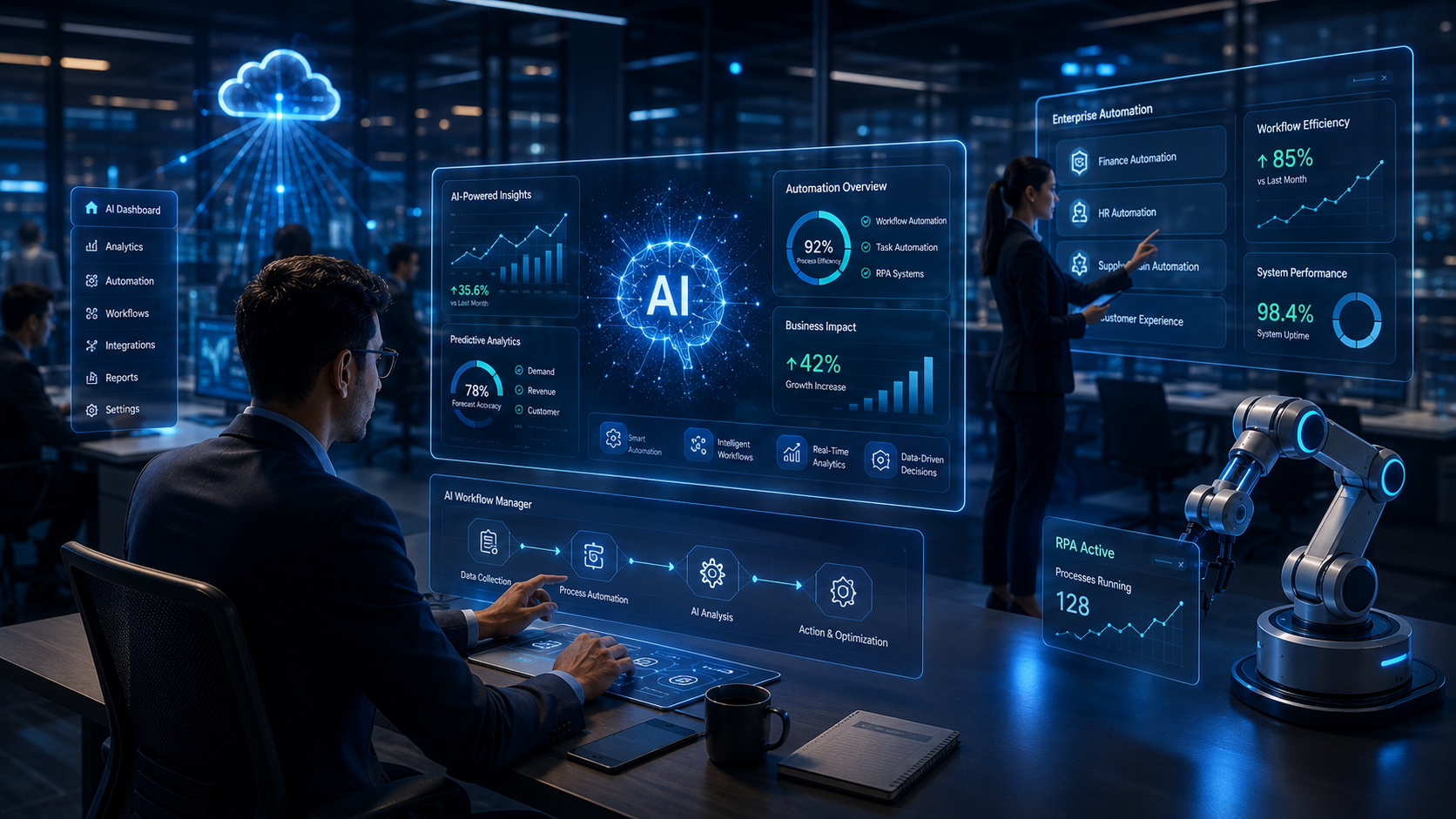
How AI and Automation Are Changing Modern Businesses
Artificial intelligence and automation are transforming modern businesses by improving efficiency, reducing manual work, enhancing customer experience, and supporting scalable digital growth.
Introduction
Artificial Intelligence (AI) and automation are rapidly transforming the way modern businesses operate, communicate, and grow. Across industries, organizations are adopting intelligent technologies to improve efficiency, reduce operational complexity, enhance customer experiences, and support long-term digital transformation.
In 2026, AI is no longer limited to large technology companies. Small and medium businesses are increasingly using AI-powered tools and automation systems to streamline operations, improve productivity, and gain competitive advantages in evolving digital markets.
From customer support and marketing automation to analytics, workflow management, and predictive decision-making, AI technologies are becoming essential components of modern business ecosystems.
Businesses that strategically adopt AI and automation position themselves for stronger scalability, innovation, and operational efficiency.
What Is Artificial Intelligence in Business?
Artificial Intelligence refers to technology systems capable of performing tasks that typically require human intelligence.
In business environments, AI is commonly used for:
- data analysis,
- customer interactions,
- automation,
- personalization,
- decision-making,
- and operational optimization.
AI systems can process large amounts of information, identify patterns, and automate repetitive tasks more efficiently than traditional manual processes.
Modern businesses use AI to improve:
- productivity,
- customer engagement,
- workflow management,
- and digital operations.
What Is Business Automation?
Business automation involves using technology to automate repetitive tasks and workflows with minimal human intervention.
Automation systems help businesses manage:
- customer communication,
- invoicing,
- reporting,
- lead management,
- appointment scheduling,
- email campaigns,
- and operational processes.
Automation reduces manual workload, improves consistency, and allows teams to focus on higher-value business activities.
When combined with AI, automation becomes more intelligent, adaptive, and scalable.
AI Improves Operational Efficiency
One of the biggest advantages of AI and automation is improved operational efficiency.
Businesses often spend significant time handling repetitive tasks that can be automated through intelligent systems.
AI-powered automation helps businesses:
- reduce manual processes,
- improve workflow speed,
- minimize human error,
- and increase productivity.
Examples include:
- automated customer support,
- AI chat systems,
- workflow automation,
- document processing,
- and predictive analytics.
Efficiency improvements help businesses save time and optimize resource allocation.
AI Enhances Customer Experience
Modern customers expect:
- faster responses,
- personalized communication,
- seamless support,
- and digital convenience.
AI technologies help businesses improve customer experience through:
- chatbots,
- recommendation systems,
- automated support,
- personalized marketing,
- and intelligent customer engagement tools.
AI-driven systems can analyze customer behavior and provide more relevant interactions, improving satisfaction and engagement.
Businesses using AI-powered customer experiences often achieve stronger customer retention and brand loyalty.
Automation Supports Business Scalability
As businesses grow, operational complexity increases. Managing larger customer bases and workflows manually becomes increasingly difficult.
Automation helps businesses scale more efficiently by streamlining operations without significantly increasing workload or staffing requirements.
Automated systems support:
- lead management,
- CRM operations,
- project tracking,
- inventory management,
- and communication workflows.
Scalable automation infrastructure allows businesses to handle growth more effectively while maintaining operational quality.
AI Improves Data-Driven Decision Making
Modern businesses generate large amounts of data from:
- customer interactions,
- websites,
- sales systems,
- marketing campaigns,
- and operational processes.
AI-powered analytics tools help businesses process this data more efficiently and identify actionable insights.
AI supports:
- predictive analysis,
- customer behavior analysis,
- sales forecasting,
- and operational optimization.
Businesses using AI-driven insights can make smarter and faster strategic decisions.
AI Is Transforming Marketing Strategies
AI technologies are significantly improving digital marketing performance.
Businesses use AI for:
- content recommendations,
- audience targeting,
- automated advertising,
- SEO optimization,
- and customer segmentation.
AI-powered marketing systems help businesses:
- improve campaign performance,
- increase conversion rates,
- and personalize customer communication.
Automation also helps businesses manage:
- email campaigns,
- lead nurturing,
- social media scheduling,
- and analytics reporting.
These capabilities improve marketing efficiency and customer engagement.
Workflow Automation Reduces Human Error
Manual processes often create operational inefficiencies and inconsistencies.
Automation systems improve:
- accuracy,
- reliability,
- consistency,
- and process management.
Businesses using workflow automation reduce:
- repetitive tasks,
- delays,
- operational errors,
- and administrative complexity.
This improves productivity while supporting better operational control.
AI Is Reshaping Customer Support
Customer service has become one of the most important areas influenced by AI.
AI-powered chatbots and support systems help businesses provide:
- instant responses,
- 24/7 support,
- automated ticket handling,
- and faster issue resolution.
These systems improve customer satisfaction while reducing support workload.
AI support tools can also assist human teams by organizing customer inquiries and providing relevant information quickly.
Automation Helps Businesses Reduce Costs
Operational inefficiencies often increase business expenses over time.
Automation helps reduce costs by:
- improving efficiency,
- minimizing repetitive manual work,
- reducing errors,
- and optimizing resource usage.
Businesses implementing automation strategically often improve productivity while controlling operational costs more effectively.
This is especially valuable for growing SMEs seeking scalable operations.
AI Supports Innovation and Competitive Growth
Businesses adopting AI technologies often gain competitive advantages through:
- faster decision-making,
- improved customer experiences,
- stronger efficiency,
- and better operational agility.
AI also enables businesses to innovate more effectively by identifying trends, optimizing workflows, and improving strategic planning.
As digital markets continue evolving, AI-driven innovation becomes increasingly important for long-term competitiveness.
Challenges Businesses Face With AI Adoption
Although AI offers major benefits, businesses may face challenges such as:
- implementation complexity,
- technical expertise requirements,
- integration issues,
- and change management.
Businesses should adopt AI strategically based on operational needs and long-term goals.
Successful AI implementation often requires scalable planning and professional digital infrastructure.
The Future of AI and Automation in Business
AI and automation technologies are expected to become even more integrated into business operations over the coming years.
Future business ecosystems will increasingly rely on:
- intelligent automation,
- predictive systems,
- AI-driven analytics,
- smart workflows,
- and digital decision-making tools.
Businesses that adopt AI early position themselves for stronger competitiveness, operational flexibility, and digital transformation readiness.
AI is not replacing businesses — it is helping businesses operate smarter, faster, and more efficiently.
Conclusion
Artificial Intelligence and automation are reshaping the future of modern businesses by improving productivity, efficiency, customer engagement, and operational scalability.
Businesses investing in AI-powered systems and automation technologies gain significant advantages in digital transformation, workflow optimization, and customer experience management.
As modern markets become increasingly technology-driven, AI adoption will continue playing a major role in business growth and competitiveness.
Organizations that strategically integrate AI and automation today will be better prepared for the future digital economy.
NexivaGen Technologies helps businesses implement scalable AI-powered solutions, automation systems, and modern digital technologies designed for long-term business growth and operational efficiency.
Frequently Asked Questions
Frequently Asked Questions (FAQ)
What is AI in business?
AI in business refers to the use of artificial intelligence technologies to improve operations, automation, customer experience, and decision-making.
How does automation help businesses?
Automation reduces repetitive tasks, improves efficiency, minimizes errors, and supports scalable operations.
Can small businesses use AI technologies?
Yes. Many AI tools and automation systems are scalable and suitable for small and medium businesses.
How does AI improve customer experience?
AI improves customer experience through personalized interactions, chatbots, faster responses, and intelligent support systems.
What industries benefit from AI and automation?
Healthcare, retail, IT services, manufacturing, education, finance, logistics, and many other industries benefit from AI technologies.
Does AI replace human employees?
AI primarily supports and enhances human work by automating repetitive tasks and improving operational efficiency.
How does AI support digital marketing?
AI helps with audience targeting, analytics, content recommendations, SEO optimization, and automated marketing campaigns.
What is workflow automation?
Workflow automation involves using technology to automate business processes and repetitive operational tasks.
Why is AI important for modern businesses?
AI improves productivity, decision-making, scalability, customer engagement, and competitiveness in digital markets.
How can businesses start using AI?
Businesses can begin with automation tools, AI chat systems, analytics platforms, CRM automation, and digital workflow solutions.