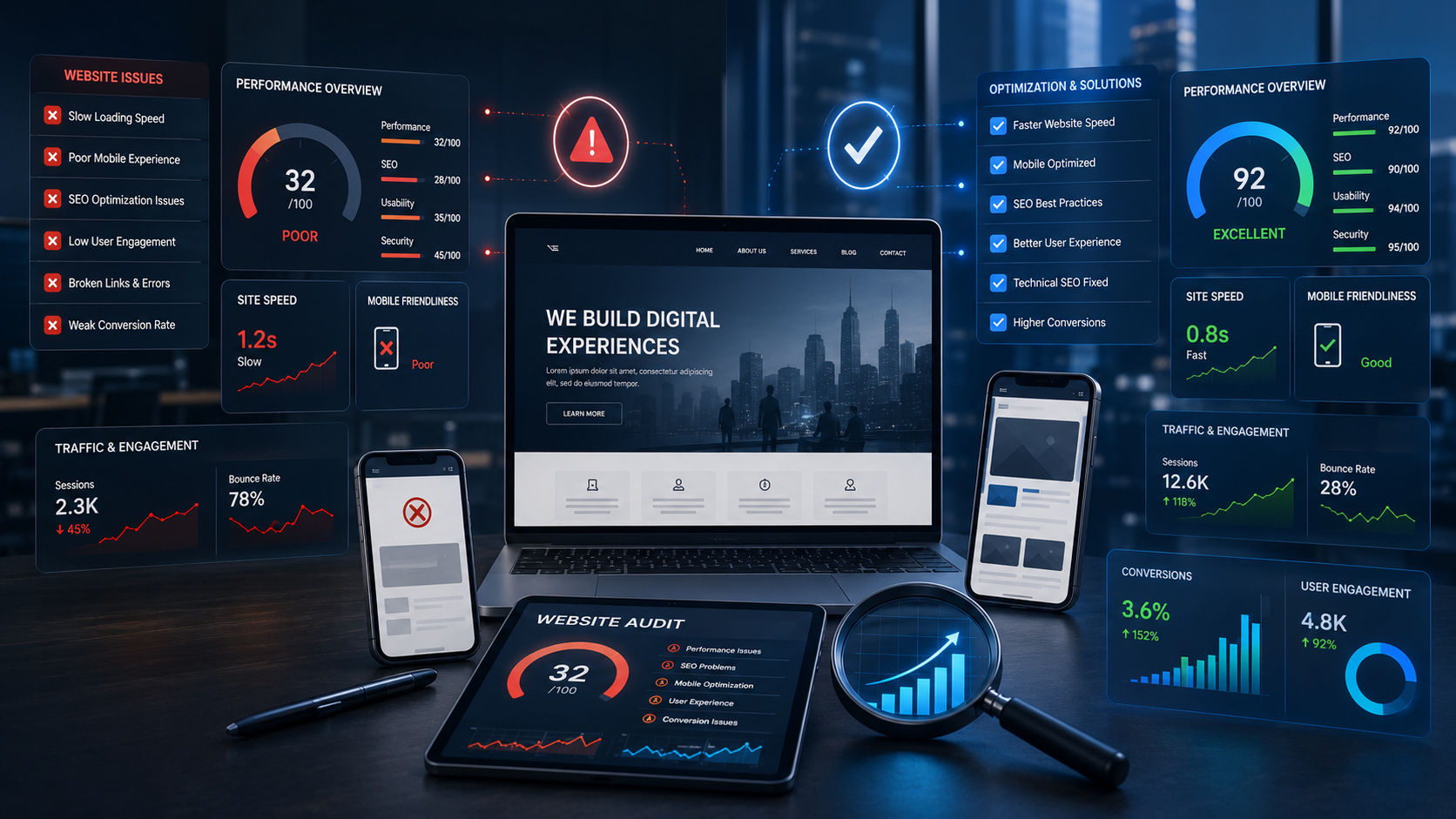
Website Mistakes That Hurt Business Growth
Many businesses lose customers due to website mistakes that affect SEO, user experience, trust, and conversions. Learn the most common website issues and how to improve business growth through website optimization.
Common Website Mistakes That Reduce Business Growth and Customer Engagement
Introduction
A business website is often the first interaction potential customers have with a company. It serves as a digital storefront, information center, marketing platform, and lead generation tool all at once.
However, many businesses invest in a website and assume the job is complete. In reality, simply having a website is not enough. If a website is poorly optimized, difficult to use, slow to load, or lacking strategic structure, it can actively prevent business growth rather than support it.
Many companies unknowingly lose valuable leads because of common website mistakes that affect search visibility, user experience, customer trust, and conversion performance.
A professional website should help businesses:
- Attract visitors
- Build credibility
- Engage customers
- Generate inquiries
- Support long-term growth
When these objectives are not achieved, the website may be creating barriers rather than opportunities.
Understanding the most common website mistakes is the first step toward improving website performance and maximizing business growth.
Why Website Performance Matters
Modern customers expect fast, professional, and easy-to-use websites.
When visitors arrive on a website, they evaluate:
- Design quality
- Loading speed
- Ease of navigation
- Content relevance
- Mobile usability
- Trustworthiness
These factors directly influence whether a visitor remains on the website or leaves.
A website that provides a poor experience can result in:
- Higher bounce rates
- Lower customer engagement
- Reduced trust
- Fewer inquiries
- Lost sales opportunities
Website optimization plays a critical role in supporting customer acquisition and business success.
Mistake #1: Slow Website Speed
Website speed is one of the most common and damaging problems businesses face.
Users expect pages to load quickly.
When a website loads slowly, visitors often leave before exploring services or contacting the business.
Slow websites negatively impact:
- Customer experience
- SEO rankings
- Engagement
- Conversion rates
Common causes of slow websites include:
- Large image files
- Poor hosting
- Unoptimized code
- Excessive plugins
- Lack of caching
Improving website speed can significantly increase engagement and customer satisfaction.
Mistake #2: Poor Mobile Experience
Most website traffic now comes from mobile devices.
Businesses that ignore mobile optimization risk losing a large portion of potential customers.
Common mobile issues include:
- Broken layouts
- Small text
- Difficult navigation
- Unresponsive elements
- Slow mobile performance
Google also uses mobile-first indexing, making mobile optimization essential for SEO.
Responsive website design improves:
Businesses should create content that:
Modern website design improves:
- Accessibility
- User experience
- Search rankings
- Conversion performance
Mistake #3: Weak Website Navigation
Visitors should be able to find information quickly and easily.
Confusing navigation frustrates users and increases bounce rates.
Common navigation mistakes include:
- Too many menu options
- Unclear page labels
- Poor website structure
- Hidden information
-
Effective navigation helps users:
- Understand services
- Explore content
- Find contact information
- Complete desired actions
-
Simple navigation improves engagement and user satisfaction.
Mistake #4: Lack of Clear Calls-to-Action
Many websites fail because they do not guide visitors toward meaningful actions.
Visitors should clearly understand what to do next.
Examples include:
- Request a consultation
- Contact the business
- Schedule a meeting
- Download resources
- Submit inquiries
-
Without clear calls-to-action (CTAs), visitors may leave without engaging further.
Strategic CTAs improve lead generation and conversion rates.
Mistake #5: Poor SEO Optimization
A beautiful website has limited value if customers cannot find it.
Many websites struggle because they lack proper SEO optimization.
Common SEO mistakes include:
- Missing keywords
- Poor metadata
- Weak content
- Technical issues
- Lack of internal linking
-
SEO helps businesses improve:
- Search visibility
- Organic traffic
- Lead generation
- Online presence
-
Website SEO should be a core part of every business website strategy.
Mistake #6: Outdated Design and Branding
Customers often judge businesses based on website appearance.
An outdated design may create the impression that a business is:
- Unprofessional
- Inactive
- Less trustworthy
- Credibility
- Brand perception
- User experience
- Customer confidence
-
Professional branding and design contribute significantly to customer trust.
Mistake #7: Low-Quality Content
Content plays a major role in both SEO and customer engagement.
Poor content often results in:
- Lower rankings
- Reduced trust
- Weak engagement
- Answers customer questions
- Explains services
- Demonstrates expertise
- Supports SEO goals
-
Educational content also helps businesses build authority and improve visibility.
Mistake #8: Missing Trust Signals
Visitors want reassurance before contacting a business.
Trust signals include:
- Testimonials
- Reviews
- Certifications
-
Without trust indicators, visitors may hesitate to engage.
Strong trust signals improve credibility and increase conversions.
Mistake #9: Ignoring Website Security
Website security affects both trust and SEO.
Users expect secure websites.
Businesses should implement:
- HTTPS certificates
- Secure hosting
- Regular updates
-
Security issues can damage reputation and reduce customer confidence.
Google also favors secure websites in search results.
Mistake #10: Not Tracking Performance
Many businesses operate websites without measuring performance.
Without analytics, businesses cannot identify:
- Visitor behavior
- Traffic sources
- Conversion rates
-
Tools such as website analytics help businesses make data-driven decisions.
Performance tracking supports continuous optimization and growth.
The Importance of Regular Website Audits
Website optimization is an ongoing process.
Regular website audits help businesses identify:
- Technical issues
- SEO problems
- User experience challenges
-
Audits allow organizations to continuously improve website effectiveness.
Businesses that regularly evaluate their websites often achieve stronger long-term results.
How Website Optimization Supports Business Growth
Website optimization helps businesses:
- Improve customer engagement
- Increase search visibility
- Generate more leads
-
A well-optimized website becomes a valuable business asset capable of supporting marketing, sales, and customer acquisition efforts.
Businesses investing in optimization position themselves for stronger digital growth.
Conclusion
Many businesses unknowingly lose customers because of common website mistakes that affect SEO, usability, trust, and conversions.
Problems such as slow loading speed, poor mobile experience, weak navigation, lack of SEO optimization, outdated design, and missing trust signals can significantly limit business growth.
The good news is that these issues are often fixable through strategic website optimization and regular audits.
By identifying and addressing website weaknesses, businesses can improve customer engagement, increase visibility, generate more leads, and create stronger foundations for long-term success.
A website should be more than an online brochure—it should be a growth engine that actively supports business objectives.
- Build trust
- Enhance user experience
- Performance bottlenecks
- Improvement opportunities
- Data protection measures
- Awards
- Case studies
- Client logos
Frequently Asked Questions
Frequently Asked Questions (FAQ)
What are the most common website mistakes businesses make?
Common mistakes include slow loading speed, poor mobile design, weak SEO, confusing navigation, outdated design, and missing calls-to-action.
How does website speed affect business growth?
Slow websites increase bounce rates, reduce engagement, hurt SEO rankings, and lower conversion opportunities.
Why is mobile optimization important?
Mobile optimization improves user experience, search rankings, accessibility, and customer engagement.
What is website optimization?
Website optimization involves improving performance, SEO, usability, security, and conversion effectiveness.
How does SEO help business websites?
SEO improves search visibility, attracts targeted traffic, and increases lead generation opportunities.
What is a website audit?
A website audit is a detailed evaluation of website performance, SEO, usability, and technical issues.
Why are calls-to-action important?
CTAs guide visitors toward actions such as contacting the business, requesting consultations, or submitting inquiries.
How can businesses improve customer engagement on websites?
Businesses can improve engagement through better design, faster performance, quality content, clear navigation, and strategic CTAs.
Does website security affect SEO?
Yes. Secure websites improve trust and can positively influence search rankings.
How often should businesses audit their websites?
Most businesses should perform website audits regularly, ideally every few months, to identify improvement opportunities.