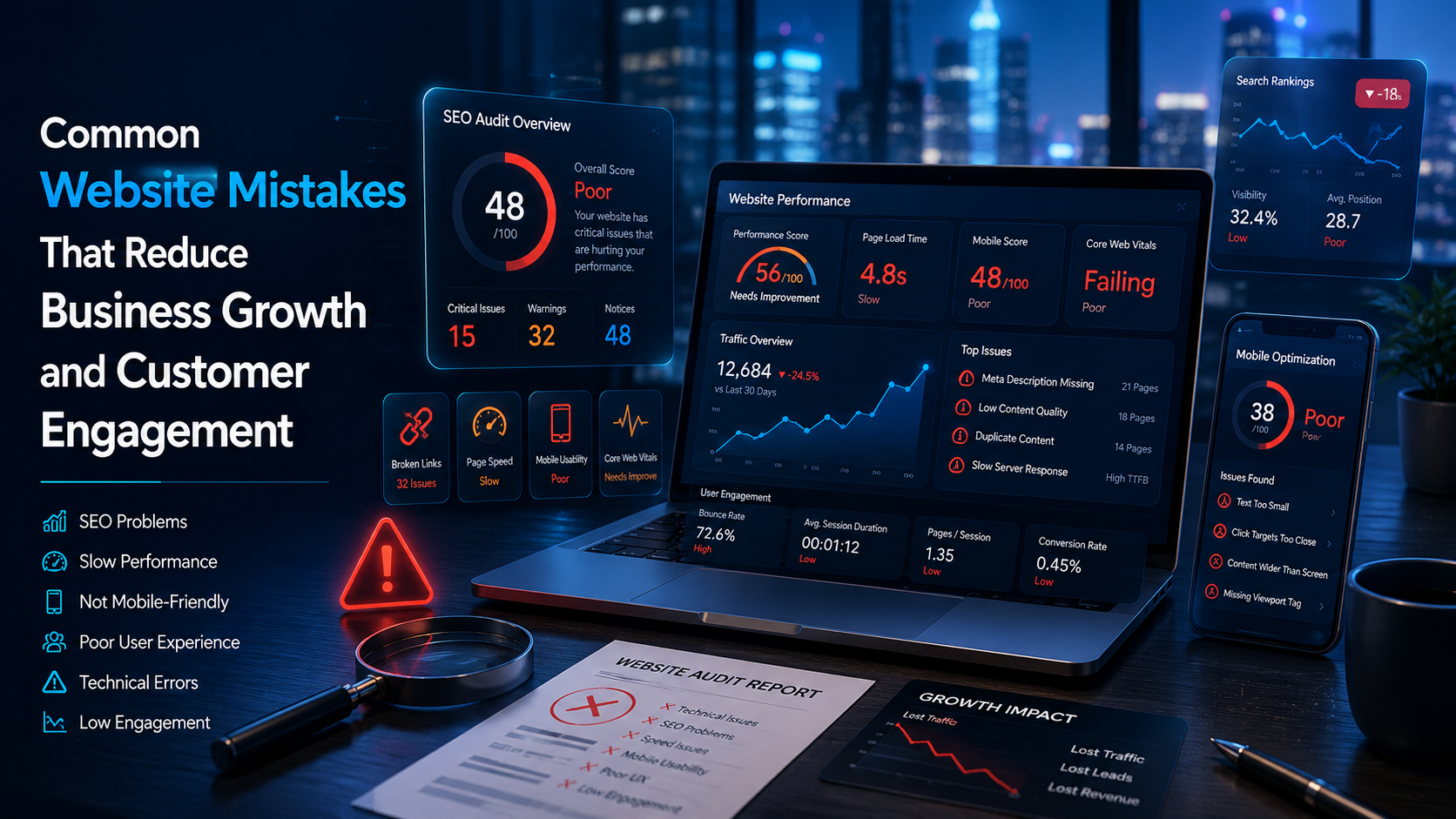
Website Mistakes That Reduce Business Growth
Many businesses lose traffic, leads, and customer trust because of poor website optimization, slow performance, weak SEO, and outdated user experience.
Introduction
In today’s digital economy, a business website is more than an online presence — it is a critical business growth asset. Modern customers expect websites to provide fast performance, professional presentation, mobile responsiveness, useful information, and seamless user experiences.
However, many businesses unknowingly operate websites filled with optimization mistakes that negatively affect:
- Google rankings,
- customer trust,
- lead generation,
- engagement,
- and business growth.
Even businesses investing in marketing often struggle because their websites fail to support conversions, SEO visibility, and customer experience effectively.
In 2026, poorly optimized websites create major disadvantages in increasingly competitive digital markets.
Businesses must understand how website mistakes directly influence SEO performance, customer perception, and long-term digital growth.
Why Website Optimization Matters
Website optimization affects:
- search engine visibility,
- user experience,
- customer trust,
- conversion rates,
- and engagement.
Google prioritizes websites that provide:
- fast loading speeds,
- mobile responsiveness,
- quality content,
- secure browsing,
- and positive user experiences.
Customers also expect websites to function smoothly across devices and provide easy access to information.
Businesses with optimized websites often achieve:
- higher rankings,
- stronger engagement,
- more inquiries,
- and better lead generation.
Mistake 1: Slow Website Speed
One of the most common business website problems is poor loading speed.
Slow websites negatively affect:
- SEO rankings,
- user experience,
- bounce rates,
- and customer trust.
Modern users expect websites to load quickly. If pages take too long to open, visitors often leave before interacting with content.
Google also considers website speed an important ranking factor.
Common causes of slow websites include:
- unoptimized images,
- excessive scripts,
- poor hosting,
- outdated development,
- and unnecessary plugins.
Website speed optimization improves both:
- search visibility,
- and customer engagement.
Mistake 2: Non-Mobile-Friendly Design
Most users now browse websites through smartphones.
Businesses with websites that are not mobile-responsive risk:
- poor user experience,
- lower rankings,
- and reduced engagement.
Google uses mobile-first indexing, meaning mobile performance strongly affects rankings.
Mobile-friendly websites improve:
- accessibility,
- readability,
- navigation,
- and conversions.
Responsive design has become essential for modern business websites.
Mistake 3: Weak SEO Optimization
Many websites fail because they are not optimized for search engines.
Common SEO mistakes include:
- missing keywords,
- weak metadata,
- poor content structure,
- duplicate pages,
- missing ALT text,
- and poor internal linking.
Without SEO optimization, Google struggles to understand website relevance.
Businesses should optimize:
- page titles,
- meta descriptions,
- headings,
- content structure,
- and keyword relevance.
SEO-friendly websites improve visibility and organic traffic.
Mistake 4: Poor User Experience (UX)
Confusing website layouts reduce customer engagement.
Businesses often lose visitors because of:
- difficult navigation,
- cluttered layouts,
- unclear information,
- and poor design structure.
Good user experience helps visitors:
- find information quickly,
- navigate easily,
- and interact comfortably.
Professional UX design improves:
- engagement,
- trust,
- and conversion opportunities.
Mistake 5: Outdated Website Design
Outdated websites often appear:
- unprofessional,
- unreliable,
- or inactive.
Modern customers judge businesses based on digital presentation.
Websites with:
- old designs,
- inconsistent branding,
- low-quality visuals,
- or outdated interfaces
can reduce customer trust significantly.
Modern professional websites improve:
- credibility,
- business reputation,
- and brand authority.
Mistake 6: Weak Content Strategy
Content quality strongly affects SEO and engagement.
Many business websites contain:
- thin content,
- generic pages,
- outdated information,
- or poor educational value.
Google prioritizes high-quality content that:
- answers user questions,
- provides value,
- and demonstrates expertise.
Businesses should publish:
- educational blogs,
- service-focused content,
- FAQs,
- and industry insights.
Strong content strategies improve:
- topical authority,
- search rankings,
- and customer trust.
Mistake 7: No Clear CTA Structure
Many websites fail because they do not guide users toward actions.
Businesses should include clear CTAs such as:
- contact forms,
- consultation requests,
- service inquiries,
- and lead generation forms.
Without conversion-focused structure, websites may receive traffic but fail to generate business results.
Strategic CTA placement improves:
- engagement,
- inquiries,
- and conversions.
Mistake 8: Poor Technical SEO
Technical SEO issues often prevent proper indexing and ranking.
Common technical problems include:
- broken links,
- crawl errors,
- missing sitemap,
- indexing problems,
- poor URL structure,
- and duplicate content.
Businesses should regularly perform technical audits to improve:
- website health,
- crawlability,
- and ranking performance.
Technical SEO forms the foundation of search visibility.
Mistake 9: Lack of Internal Linking
Internal linking helps:
- Google understand website structure,
- improve crawlability,
- distribute authority,
- and increase engagement.
Many businesses publish content without connecting related pages.
Every article should link strategically to:
- related blogs,
- service pages,
- consultation pages,
- and educational resources.
Strong internal linking improves:
- SEO performance,
- session duration,
- and topical authority.
Mistake 10: Ignoring EEAT Signals
Google increasingly prioritizes:
- Experience,
- Expertise,
- Authoritativeness,
- and Trustworthiness (EEAT).
Businesses should demonstrate:
- industry expertise,
- professional authority,
- transparency,
- and reliable content quality.
EEAT signals help improve:
- credibility,
- trust,
- and ranking potential.
Professional branding and educational authority content strengthen EEAT.
Why Many Business Blogs Fail to Rank
Many businesses publish blogs without proper SEO strategy.
Common reasons include:
- inconsistent posting,
- low-quality AI content,
- weak keyword targeting,
- lack of search intent,
- poor formatting,
- and no authority structure.
To rank effectively, blogs should:
- target business search intent,
- solve customer problems,
- use semantic SEO,
- and provide real educational value.
Google rewards helpful, authoritative, and optimized content.
How NexivaGen Insights Should Be Structured
To improve indexing and rankings, your articles should include:
- SEO-focused titles
- High-intent keywords
- Long-form educational structure
- Strong heading hierarchy
- Internal linking
- FAQ sections
- Optimized images
- EEAT-focused content
- Business-focused search intent
- Consistent publishing schedule
This creates:
- topical authority,
- better indexing,
- and long-term ranking potential.
Long-Term SEO Strategy for Ranking Higher
To rank higher on Google consistently:
- publish regularly,
- target niche business topics,
- build internal content clusters,
- optimize technical SEO,
- improve website speed,
- and focus on authority-based educational content.
SEO growth is cumulative.
The more high-quality interconnected content you publish, the stronger your website authority becomes.
Conclusion
Website optimization directly affects customer trust, search visibility, engagement, and business growth. Businesses operating poorly optimized websites often lose traffic, leads, and credibility without realizing the impact.
Modern websites must provide:
- strong SEO structure,
- fast performance,
- mobile responsiveness,
- quality content,
- and professional user experience.
Businesses investing in website optimization and educational SEO content position themselves for long-term digital growth and stronger online competitiveness.
NexivaGen Technologies helps businesses improve website performance, SEO visibility, customer engagement, and digital growth through professional optimization strategies and modern business website solutions.
Frequently Asked Questions
Frequently Asked Questions (FAQ)
Why are my business blogs not ranking on Google?
Blogs often fail to rank because of weak SEO, poor keyword targeting, low authority, short content, or lack of search intent optimization.
How does website speed affect SEO?
Slow websites reduce user experience and negatively impact Google rankings and customer engagement.
Why is mobile responsiveness important?
Google uses mobile-first indexing, and most users browse websites on smartphones.
What is technical SEO?
Technical SEO involves optimizing website infrastructure for better crawling, indexing, and ranking performance.
Why is internal linking important?
Internal linking improves crawlability, SEO authority distribution, and user engagement.
What are EEAT signals?
EEAT stands for Experience, Expertise, Authoritativeness, and Trustworthiness — important Google quality factors.
How often should businesses publish blogs?
Consistent publishing is important. Weekly high-quality educational content improves authority and SEO growth.
Can website redesign improve rankings?
Yes. Modern optimized websites improve speed, UX, mobile performance, SEO, and customer trust.